On the Road Again

Thursday Evening, July 1
Tomorrow morning I am on the road again. It was nice to stop in Burns to do laundry and regroup after four nights and three nights camped out. It will be three days of walking to my next civilized outpost - Juntura, Oregon. I should arrive there July 4. It has only one motel which I telephoned earlier to reserve a room and was told, "Sorry, we're full." Can you believe that? They said they have a RV park in which I could place my tent. Hopefully they will have a shower I can use. It seems strange that I do not have a 4th of July performance. Last year I performed to a crowd in Springfield but this year I'll be camped between RV's in the middle of nowhere. The motel also runs the only restaurant. Maybe I will put on my "Son of Liberty" outfit and wow the patrons whoever they may be. Who knows, trust in the unknown.
Anyway, I'll be out of Burns in the morning but my smell will not. After only 300 miles my shoes are beginning to ripen. My olfactory senses take me back to those earlier years as a teenage boy. I can still hear dear old mom,"Leave those damn shoes outside!"
Sorry, I hope the maid leaves the door open awhile

The Flag and the Constitution

Two hundred thirty-six years ago, 56 men staked their lives on the idea that no government may lay claim to that which is granted by our Creator - that all men are born inherently free.

Our Declaration of Independence states that the purpose of government is to facilitate the people, equally born, in the pursuit of their individual and collective happiness. The Preamble to the Constitution further charges our government with the responsibility of protecting and promoting the lives of its citizens while securing the blessings of liberty - for Americans of that generation - as well as for the generations yet unborn.

In adopting our Constitution, many of the founders remained unsatisfied, for “power and liberty are often at odds” and the oppressive nature of government is to erode the rights of the people. Therefore, they created our great Bill of Rights to serve all citizens as a shield of perpetual protection against the weight of government and the potential tyranny of the majority.

It is this belief in personal sovereignty that makes Americans unique. What is an American? I answer that Americans are a diverse group of people drawn from all parts of the world. We have no official religion, no national party, not inherited titles. To know an American, one must know our Constitution, for therein lies the foundation of our government, our evolution as a people and the bedrock of what we have become today. This Fourth of July, fly the flag - but wave the Constitution!

Civil War Drawings

These Civil War drawings are the last art works by my students. As we think about the true meaning of the Fourth of July I hope they will add to your day.

What is Patriotism?


When I ask about the idea of patriotism, people seem to fall into one of two camps. There are those that jump up waving the flag, proud of who we are as a nation. They, unashamed and unabashed, are quick to say that they love their country and make no apologies for it. How anyone could not be a cheering patriot is beyond their comprehension.
On the other hand, there are those that react as if a preacher had just asked about their religious beliefs. They cringe slightly uncomfortably, mumble something and try to change the subject - or they launch into an angry diatribe about how screwed up the country is! No way, in their opinion, could they ever be a patriot.
I offer that we are all patriots - but some do not recognize it as readily as others.
Quite simply, patriotism is loving and caring for your country. How can you not love the country of your adoption or birth? It is as easy and natural as loving your own parents or children.
As a parent, I love my children - period. I may not always love what they say or support what they do - but I love them. I can argue with them, I can tell them they are ruining their lives, I can be ashamed or proud - but I love them just the same.
I grew up during the 60’s when patriotism seemed to go out of style for those that disagreed with governmental policies. Dissenters were told, “America - Love it or Leave it” by bumper stickers of that era. I honestly saw this printed on a flag just two days ago while walking down the road. Hasn't it always really meant “Support the United States governmental policy or get out!" Therefore, I have never agreed with those words for my definition of patriotism.
You can be patriotic and:
Never wave a flag.
Never sing a patriotic song.
Never stand and recite the Pledge of Allegiance.
You can be patriotic and:
Disagree with national policy.
Never serve in the military.
Protest wrongs trying to make things right.
This country was build on dissent and dissenters. It is all there, just read the history.
Yes, it is great to wave the flag. It is an honor to serve in the armed forces. I still enjoy covering my heart during the Star Spangled Banner. Yet as I walk across this country, I wish to hear differing political views. How boring things would be if but one flavor was offered. I value differences. I want to hear from you - anyone - just have an opinion!
I believe the real enemy to our country is not “out there” but rather right here at home - apathy. An apathy caused by feelings of disassociation and futility shared by too many Americans today. This country was founded on civic participation and we, as citizens, must continue to engage or the system will no longer serve us. We cannot afford to abandon our civic responsibilities. I believe that if each does but a small part, great things can happen.
Beware of those who grab the flag as if it were their own. No one group holds a monopoly on patriotism.  Patriotism is not defined by cheering loudly, waving a bigger flag, or singing praise with the highest notes. It is simply loving your country and participating with others to help move this great nation forward.
"Has anyone seen my flag?"

The Declaration of Independence

Thursday, July 1
Since I will be unable to blog for probably a week or perhaps longer, I did not want Independence Day to pass unmentioned. Therefore, I have included several postings related to the day - some Civil War artwork done by my students, some musings on patriotism, a reprint of a letter to the editor I wrote a couple of years ago, and a short video excerpt of my performance last 4th of July in Springfield, Oregon.


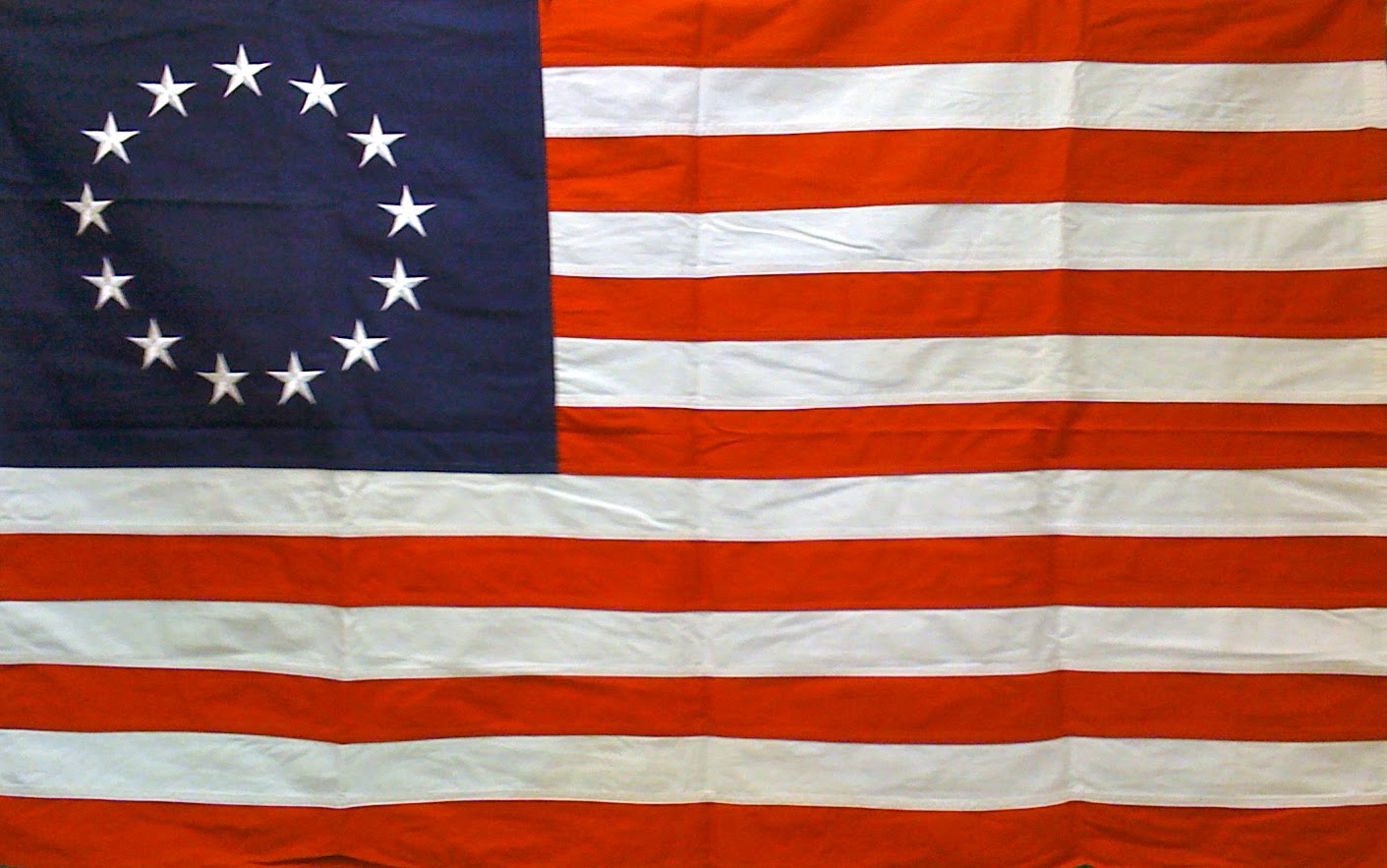
First Question: What is the significance of the pictured flag above?

Second Question: Who authored these words and what was their significance?
"That these United Colonies are, and of Right ought to be, Free and Independent States, that they dissolved from all Allegiance to the British Crown, and that all political Connection between them and the State of Great Britain, is, and ought to be totally dissolved."
Approved July 2, 1776 by the 2nd Continental Congress.

Did you know that the Declaration of Independence is only 2/3's Jefferson's. The other 1/3 was authored in bits and pieces by "other cooks in the kitchen," much to Jefferson's dismay.

The words "United States of America" appear for the first time in the Declaration of Independence.

200+ copies were printed on the night of July 4, of which only 26 are known to exist. There are called the Dunlap Editions and one set a record price paid for an American document at $8,140,000.

Contrary to popular belief, historians doubt that the Pennsylvania Statehouse Bell (dubbed the "Liberty Bell" many years later by abolitionists) was actually rung after the reading of the Declaration in Philadelphia.

During WWII, the Declaration of Independence was taken by a United States Calvary Unit and the Secret Service to Fort Knox, Kentucky, by train for safe storage.

It was almost 45 years before the American public first viewed the original Declaration of Independence.

The signers did not publish their names until almost six months later (other than John Hancock and his Secretary Charles Thompson). In January, having fled Philadelphia and temporarily residing in Baltimore, Maryland, Congress commissions the third edition of the Declaration of Independence with the signers names made public for the first time. Published January 18, 18777, this edition is known today as the "Goodard Edition" named after Mary Katherine Goodard, the first woman Postmaster in the United States who also owned an inherited printing press and published the document for Congress.

The Declaration took two weeks to pen and began being signed Aug. 2 - not the 4th of July. It was embellished (calligraphy we call it today) by Timothy Matlock, Secretary to the Secretary of Congress Charles Thompson. It contains two mistakes if you look closely.

The delegates signed the Declaration of Independence in geographical order from north to south starting with New Hampshire and ending with Georgia. Their signatures started on the right side and moved to the left as they affixed their names.

July 4, 1776, when Congress voted for independence it was not unanimous.

Benjamin Franklin is reported to have said after signing, "Now we must all hang together, or most assuredly we shall all hang separately."

The last to affix his signature, Thomas McKean, did not sign it until 1781.

Seven signers of the Declaration of Independence had not voted for independence. They were not delegates to Congress at the time of the historic vote, but affixed their names to the document.

The original Declaration of Independence is much faded for two reasons. It hung on a wall opposite a large window for many years in the U.S. Patent Office and consequently faded. Some ink was also sacrificed when a printer William J. Stone used a wet plate process to copy the original by order of John Quincy Adams in 1820 to create what we today know as the Stone Edition. Finished three years later in 1823, Congress ordered 201 copies to be printed. These were given to the three surviving signers, Lafayette of France, and other important notables of the day. Only 33 of these "Stone Editions" are known to exist.

It traveled from Washington to Philadelphia for the Centennial Celebration for display at Independence Hall but following the festivities Philadelphia did not want to give it back stating it rightfully belonged there.

Today the Declaration of Independence is kept in an argon gassed, controlled humidity, bullet proof container which lowers into a bunker at night at the National Archives in Washington D.C. along with the original Constitution and the Bill of Rights.

Americans consistently rank the Declaration of Independence as the #1 historical document of significance.

The expression, "Put your John Hancock here," when asking for a person's signature comes from Hancock being the only delegate to sign the original document.

Thomas Jefferson and John Adams, both Presidents and signers of the Declaration, died exactly 5o years to the day on July 4, 1826.

Years later, they tried to keep James Madison alive a bit longer hoping he might also succumb on the 4th of July. No such luck - he died in May.

Every signer drank alcohol.
One was a minister.
Only one was a Catholic.
Last signer to die was in 1832.

Happy Independence Day July 2 for historians, and for the rest of us - Happy 4th of July!
I really must go to bed.

* Highway 20 to Burns, Oregon